CASS SCENIC RAILROAD STATE PARK
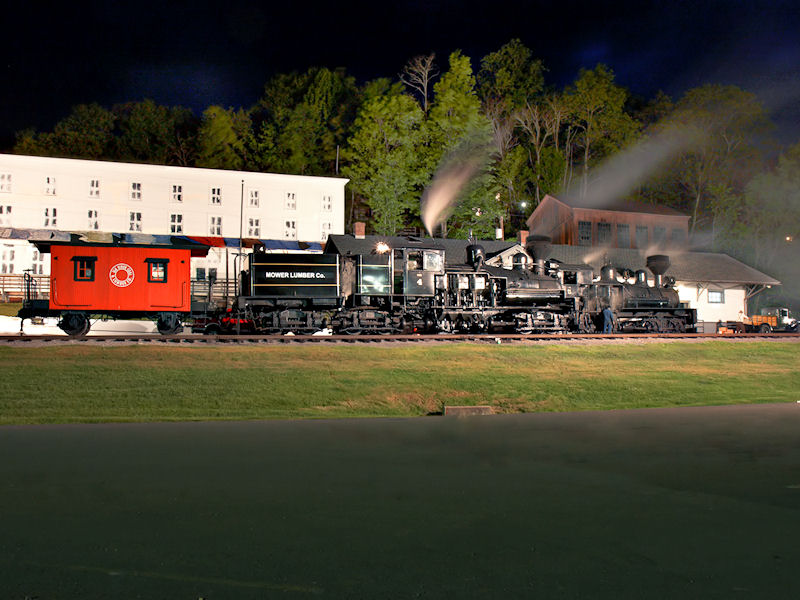
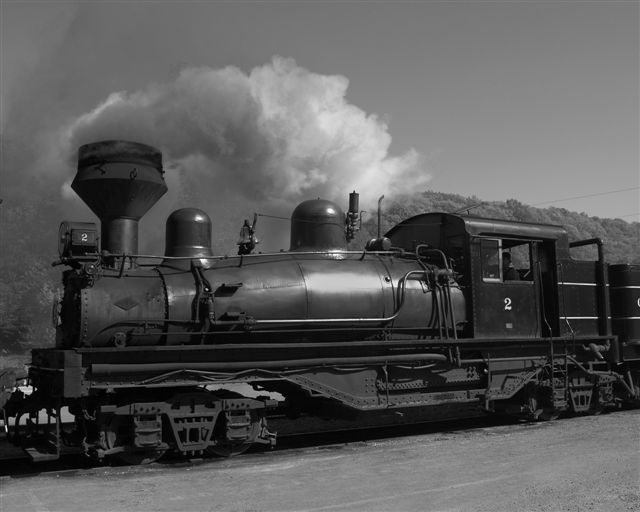
Nestled in the mountains of West Virginia, Cass Scenic Railroad State Park offers excursions that transport you back in time and let you relive an era when steam-driven locomotives were an essential part of everyday life. Trips to Cass are filled with rich histories of the past, unparalleled views of a vast wilderness area, and close-up encounters with the sights and sounds of original steam-driven locomotives.
The town of Cass remains relatively unchanged. The restored company houses add to the charm and atmosphere of the town. From the company store and museum to the train depot, you'll find an abundance of things to do prior to your departure on the historic Cass Railroad.
The history of the town of Cass follows the evolution of the lumber companies that inhabited the valley and operated the West Virginia Pulp and Paper Mill. Once a symbol of the economic power that drove this valley, the mill building has been victim of two major fires in 1978 and 1982. Now only twisted steel and rusted machinery remain amid the cracking cement. Trees and vines grow in a place where humans once toiled among the machines of lumber and fine wood products production.
The mill operation was enormous during its heyday 1908 to 1922. It ran two 11-hour shifts six days per week, cutting 125,000 board feet of lumber each shift, an impressive 1.5 million feet of lumber per week. The Cass mill also had drying kilns using 11 miles of steam pipe to dry 360,000 board feet of lumber on each run.
The adjoining planing mill was three stories high, measuring 96 by 224 feet. Massive elevators carried up to 5,000 feet of lumber to the separate floors and machines. Some of the flooring machines were so big that it took 15 men to operate them. There were two resaws here that could accommodate boards up to 35 feet long. The large surfacing machines finished all four sides of a board in one operation.
Roy Clarkson, in Tumult on the Mountain, estimated that in 40 years the Cass mill and the mill at Spruce turned more than 2-14 billion feet of timber into pulp or lumber. The town of Cass was named for Joseph K Cass (left picture), Chairman of the Board of W.Va. Pulp & Paper Co. Each morning the C&O dispatched a 44-car pulpwood train for the paper mill at Covington. At its peak, West Virginia Pulp and Paper employed between 2,500 and 3,000 men. In an average week six to 10 carloads of food and supplies traveled over the railroad to 12 logging camps. Indeed, the ruined mill is a symbol and a reminder of a past resplendent with human achievement. But the story of the mill is also a story of the rails that linked that mill with the timber in the nearby mountains.
At the turn of the century lumbermen eyeing the large tracts of virgin timber on Cheat Mountain, west of Cass, decided to route the timber east through a mountain gap and down the steep grade to the planned mill. An interchange between the Greenbrier and Elk River Railroad at Cass and the C&O was most economical but it called for the building of a difficult mountain railroad.
In 1900 Samuel Slaymaker, a timber broker, set up a construction camp at the mouth of Leatherbark Creek (the present site of the Cass shops). He and his hardy men pushed the rails up and along Leatherbark Creek, and gained altitude by constructing two switchbacks. Tracks were laid around the face of the promontory -- up and up along the ridge, winding until at last the rails reached the gap between the mountains. Here a camp named Old Spruce was established.
Around 1904, 1-1/4 miles of track were laid from Old Spruce to Spruce, a new town on the Shavers Fork on the Cheat River. At 3,853 feet, Spruce became the highest town in the eastern United States. From Spruce, the track eventually ran 35 miles south into the Elk River Basin to the town of Bergoo and 65 miles north, along Shavers Fork of Cheat River. Spruce became the hub of the rail empire. The main lines (Cass to Spruce, Spruce to Bergoo and Spruce to Cheat Junction) were 82 miles long. During the 1920s there were many miles of branches in use at once, but the total length was probably about 140 miles at maximum. Altogether the logging railroad built about 250 miles of track. At Spruce a large pulp peeling rossing mill was constructed. Billions of board feet of logs passed through Spruce and eventually went over the mountain behind the tanks of big 4 ton Shays like Number 12.
Reserve our Wilderness Cabin!We'll take you there, on top of Cheat Mountain, and you can ride the train back to civilization on the day you choose! Bring your sleeping bag and pack your own water. Cooking utensils and wood for heating are provided. Outdoor facilities are available.
Some basic information for Wilderness Cabin RentalAs you re-board the train at Bald Knob, remind the conductor (in brown uniform) of your need to be dropped off at the cabin.The wilderness cabin has no electricity, running water, or refrigeration. You should generally plan on bringing full backcountry camping gear. Items you may need for your visit include: bedding such as a sleeping bag (bed frames are provided); camping stove and fuel (wood stove and wood provided, but more difficult to use); camping light and fuel (no lighting is provided in the cabin); flashlights; matches; toilet paper; first aid kit; cooler; water purifying equipment; food, toiletries and personal items.
You will be going into a vast backcountry area part of the Monongahela National Forest at an elevation of 4,800 feet. Be prepared for weather much colder and wetter than what you would expect at lower elevations. You will also be entering black bear country and should take proper precautions in storing of food. More information will be provided to you upon reserving our wilderness cabin.
Guests visiting Cass Scenic Railroad may choose from among several completely furnished, standard, two-story cottages for their stay. Originally, houses from the turn-of-the-century logging town at Cass, these six-, eight- and ten person cottages have been totally refurbished and feature bathrooms and fully equipped kitchens, cooking utensils, tableware, towels, dishcloths and linens. Energy efficient wood stoves, available in four of the houses, and electric heaters provide heat, and one cottage is accessible to the disabled. Open year-round, the cottages are rented by the day, up to a maximum of two weeks. Cottage weeks run from 4:00 p.m. Monday to 10:00 a.m. the following Monday when renting weekly. No pets allowed in cottages.Cottage guests staying five nights or more will receive two free Cass train tickets to the destination of their choice. Contact the park office for more information.
Reservations may be made by calling or writing Cass Scenic Railroad directly, or by dialing toll free: 1 800 CALL WVA. The Cass office is open from 8:00 am to 5:00 pm 7 days a week, in the summer season, and 8:00 am to 4:00 pm on weekdays for the Winter Season (closed on Weekends). When making cottage reservations for four nights or more, a deposit of one half the rental fee is required with the balance upon arrival; for three nights or less, the full rental fee is required. If you make your reservation by telephone, you will have 10 days to make payment, unless it is a last minute reservation. In case of cancellations, deposits will be returned (with the exception of a handling fee) if notice is given 30 days in advance or if the cottage can be rented.
CABOOSE RENTALS
Cass Scenic Railroad now offers cabooses for rent by the day trip or for overnight or longer. These cabooses provide private accommodations for a small group of up to 12 people for day trips, and up to 5 people overnight. All caboose rentals are by reservation only, and in addition to the caboose rental rates below, patrons must purchase their train tickets as well.
Cass's available roster of three historic cabooses provide an exciting and special ride into history. You will be well protected against the elements, and the cupola seating provides a great view of the famous Pocahontas County scenery, especially for the kids.Each caboose is equipped with a coal heating stove and sink. Coal and drinking water are provided by the staff.




 we stayed in the company home at Cass R.R. it was very nice would do it again. the train ride was cold but beautiful enjoy the Shay engines who pulled and pushed us up the mountain. I applaud the state for saving the railroad for all the world to enjoy



 Share Your Cass Scenic Railroad State Park Photos (click here)